Download the guide
GBS SE Agent, explained in plain English (PDF) covers everything on this page in more depth: everyday comparisons, pictures, where the brain can live and what that costs, how it compares to the better-known tools, and what comes next.
What it is
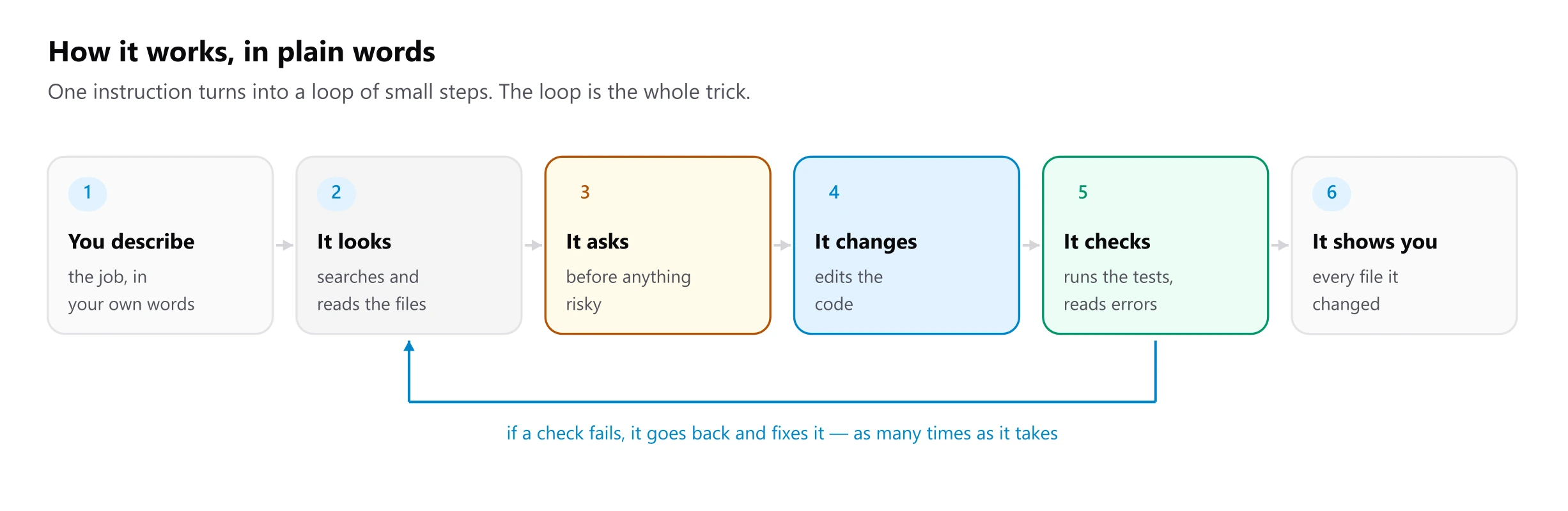
Imagine someone on their first day. They do not know where anything is, but they are quick, never get bored, and have three good habits:
- They look before they touch. They do not guess where the login code lives; they go and find it.
- They ask before anything risky. Running commands, changing settings, opening a file that looks like it holds a password: they stop and check first.
- They show their receipts. When they finish, they tell you exactly which files they touched, so you can look before anything goes out.
That is the whole product. Everything technical in these docs exists to force those three habits onto software that would otherwise happily guess.
Three words you will keep hearing
- The model is the brain. The agent has no intelligence of its own; it is the hands, the eyes and the rulebook. The thinking is done by a model, which can run on your laptop, on a company server, or be rented over the internet.
- Tokens are pieces of words, about four characters each. 750 words is roughly 1,000 tokens. You pay for tokens, and a model can only hold so many at once.
- The context window is the desk. Everything the agent is thinking about has to fit on it: the house rules, your request, every file it read, every test result. When the desk fills up, the agent tidies it, throwing away old output first and summarising only as a last resort.
Where it helps, and where a person is still needed
| It is good at | A person is still needed for |
|---|---|
| Explaining a codebase nobody on the team wrote | Deciding what should be built at all |
| Repetitive changes across many files | Judging whether the result is actually right |
| Writing the first version of tests | Anything where being confidently wrong is expensive |
| Narrowing down where a bug lives | Context nobody wrote down |
| Following conventions it was taught once | The last review before it ships |
The one-sentence version
An assistant that can read and change a codebase on its own, shows you every step it takes, asks permission before anything it cannot undo, and can run entirely on your own hardware so client code never leaves the building.